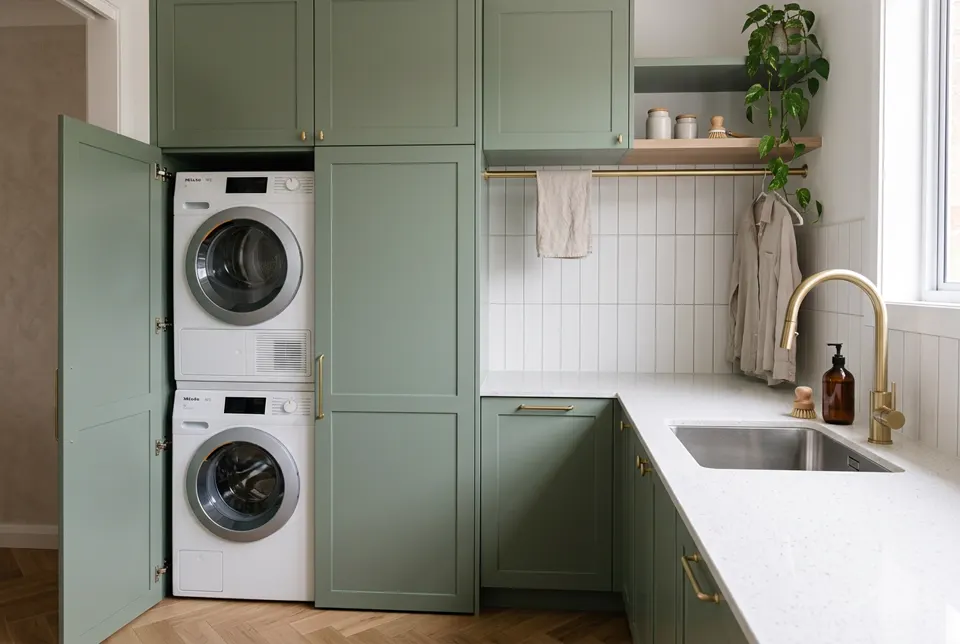
The best laundry renovation ideas for a small Sydney home keep the tub and washing machine where the plumbing already is, stack the dryer above the washer and run cupboards to the ceiling. As of 2026, a refresh costs about $3,000 to $10,000 and a full renovation $18,000 to $30,000 or more, according to CO-architecture and Three Birds Renovations. Relocating a single plumbing point can add about $1,500 to $5,000.
- A laundry refresh costs about $3,000–$8,000 (CO-architecture, 2026) or $5,000–$10,000 (Three Birds Renovations, July 2025).
- Relocating one plumbing point costs about $1,500–$5,000, according to CO-architecture.
- Under the NCC Housing Provisions, a laundry floor must be water resistant, and fully waterproof where there is a floor waste.
- A euro or cupboard laundry still needs water, drainage, power and a way to deal with dryer moisture behind the doors.
- Plumbing and electrical work needs a licensed trade at any price; renovation work over $5,000 including GST needs a licensed contractor.
What are the best laundry renovation ideas for small spaces?
In a small laundry, the best ideas save floor space and keep the plumbing where it is. Three Birds Renovations recommends keeping the sink and machines in their existing positions where possible, because moving them can be costly.
- Stack the dryer on the washing machine to free up bench space.
- Run cupboards to the ceiling and add a tall broom cupboard for the mop, bucket and vacuum.
- Fit a benchtop over front-loading machines for folding.
- Add a hanging rail or pull-down drying rack above the tub.
- Use pull-out hampers to sort washing.
- Choose large-format floor tiles, which Three Birds says can keep costs down.
- Combine overhead lighting with task lighting under the wall cupboards.
Which laundry layout suits your home?
The right layout depends on where your water, drains and power already are. Many Sydney apartments and terraces have no separate laundry, so the machines go in a cupboard, a hallway, the bathroom or the garage.
| Layout | What it is | Suits | Watch out for |
|---|---|---|---|
| Euro or cupboard laundry | Washer, dryer and a small tub behind cupboard or bifold doors | Apartments, hallways, kitchens | Ventilation, door clearance and access to taps for maintenance |
| Stacked tower | Dryer fixed above the washer in a tall cupboard | Very narrow spaces | Needs a stacking kit suited to both machines and a solid floor |
| Single-wall galley | Tub, machines and bench in one run | Small separate laundries | Keep a clear path past open machine doors |
| Combined bathroom and laundry | Machines in a bathroom cupboard or alcove | Units and small houses | Wet area rules, power point positions and strata approval |
| Garage or walk-through laundry | Laundry in a garage or back passage | Houses with a garage or side access | Dust, cold, drainage and fall to a floor waste |
Before you choose, ask a licensed plumber to check whether the drain can fall correctly from any new position. That one answer often decides the layout.
How much does a laundry renovation cost?
Most laundry renovations cost about $3,000 to $30,000 or more, depending on whether you refresh the room or rebuild it. The two sources below give slightly different bands. Both are national, not Sydney-specific.
| Band | CO-architecture (2026) | Three Birds Renovations (July 2025) |
|---|---|---|
| Refresh or cosmetic | $3,000–$8,000 | $5,000–$10,000 |
| Mid-range | $8,000–$18,000 | $10,000–$18,000 |
| Full renovation or relocation | $18,000–$30,000+ | $18,000–$30,000+ |
Indicative only. CO-architecture says most homeowners who keep the laundry in the same spot start at about $7,000–$15,000.
CO-architecture also prices the main parts of a laundry:
- Cabinetry: about $2,500 to $7,000 or more
- Benchtop: about $600 to $2,500 or more
- Sink and tapware: about $300 to $1,500 or more
- Flooring: about $700 to $2,500 or more
- Ventilation: about $300 to $800 or more for a simple installation
- Relocating a plumbing point: about $1,500 to $5,000
Three Birds suggests keeping a 10 to 20 per cent contingency and notes labour is often 40 to 50 per cent of the budget. For a full cost breakdown, see our Laundry Renovation Cost Sydney: 2026 Price Guide.
What laundry storage ideas work best?
Good laundry storage gives every item a place off the floor and off the bench.
- Full-height broom cupboard for the mop, bucket, ironing board and vacuum
- Deep drawers under the bench for detergent and cleaning products
- Pull-out hampers for sorting lights and darks
- Open shelf above the machines for baskets
- Hanging rail for shirts straight from the dryer
- Wall hooks behind the door for bags and leads
Three Birds lists built-in ironing boards, pull-out hampers, drying rails, extra-deep sinks and heated towel rails as worthwhile extras if the budget allows. Use moisture-resistant board for cabinets near the tub and machines.
Should you stack the washer and dryer?
Stacking is often the best idea in a small laundry, because it frees a whole section of bench. Use the stacking kit the manufacturer specifies for your two machines, and fix the tower so it cannot tip.
Another option is raising the machines on a cabinet plinth at a back-friendly height, which Three Birds recommends. Think about the dryer too. A vented dryer pushes warm, damp air into the room, while condenser and heat pump dryers collect most of the water. In a closed cupboard, ask about ventilation, which CO-architecture prices at about $300 to $800 or more.
Do you need to waterproof a laundry?
Yes, to the level the building code sets. Part 10.2 of the NCC 2022 Housing Provisions says a laundry floor must be water resistant. Where a floor waste is installed, the floor, the floor-to-wall junction and penetrations must be waterproof.
| Area | Requirement |
|---|---|
| Laundry floor | Water resistant |
| Floor with a floor waste | Floor, floor-to-wall junction and penetrations waterproof |
| Wall/floor junction | Water resistant; any flashing needs a horizontal leg of at least 40 mm |
| Wall behind a washing machine | Water resistant from floor level to at least 75 mm above and 75 mm each side of the tap outlets |
| Wall beside a tub within 75 mm | Water resistant to at least 150 mm above the tub, for the length of the tub |
| Floor fall to a floor waste | Between 1:80 and 1:50 |
Source: ABCB, NCC 2022 Housing Provisions Part 10.2, checked October 2026. Your certifier or waterproofer confirms what applies to your design.
In NSW, waterproofing is a licensed trade. In a strata apartment, changes that need waterproofing are major renovations that need a special resolution of the owners corporation, so get approval before you book trades.
Which benchtops and finishes suit a laundry?
Laundry surfaces need to cope with water, detergent and heavy baskets. Laminate is the budget choice. Engineered stone can no longer be installed in Australia after the 1 July 2024 ban, so people now choose laminate, compact laminate, resin-free porcelain, natural stone, timber or stainless steel.
Three Birds suggests running the benchtop material up the wall as a splashback if the budget allows, and says a small room is a good place for bolder tiles. Choose a non-slip floor tile, because laundry floors get wet.
What licences and approvals apply to a laundry renovation?
- Licences: residential building work over $5,000 including GST needs a licensed contractor. Kitchen, bathroom and laundry renovation is its own NSW licence class, and waterproofing has its own class too.
- Specialist work: plumbing, drainage and electrical work needs a licensed trade whatever it costs.
- Contracts: over $5,000 you need a written contract, and the deposit can be no more than 10 per cent.
- Council: most internal laundry renovations that do not change the structure do not need council approval.
- Strata: check your by-laws and the strata renovation rules before you start.
How do you plan a small laundry renovation?
- List what the laundry must hold: machines, tub, baskets, cleaning gear, ironing board and drying space.
- Measure the room or cupboard, and note where the taps, drain, power points and window are.
- Write down your washer and dryer models and sizes, and whether you plan to stack them.
- Decide whether the tub and machines stay where they are. This decides most of the budget.
- Choose finishes that cope with water, such as moisture-resistant cabinets and a non-slip floor tile.
- Check strata by-laws if you live in an apartment, and allow time for approval.
- Ask for itemised quotes that show cabinetry, plumbing, electrical, waterproofing and tiling separately.
Get quotes for your laundry renovation
Planning the brief? Our guide A Practical Laundry Renovation Brief for a Small Room lists what to tell trades about appliances, storage and changes.
Describe your laundry, with its size, your machines and what you want to change, to MyTradeCrew in about two minutes. We send it to up to three vetted, licensed and insured local trades from our crew who cover your area. They contact you, quote and contract with you directly, and you choose who to hire, or no one at all. It’s free for homeowners.
Frequently asked questions
Can I combine my bathroom and laundry renovation?
Yes, and it can make sense, because both rooms need a plumber, an electrician, a waterproofer and a tiler. Ask for separate costs for each room so you can compare quotes and cut back if needed. Ask for a schedule that shows when each room, and your washing machine, will be out of use.
What is the cheapest laundry upgrade that makes a difference?
Keep the layout and refresh the surfaces. New cupboard doors or a respray, a laminate benchtop over the machines, a new tub and tap, and better lighting change the room for far less than a rebuild. CO-architecture puts a basic refresh at about $3,000 to $7,000.
Should I choose a heat pump dryer for a cupboard laundry?
Often, yes. A heat pump or condenser dryer collects most of the moisture from the clothes, while a vented dryer pushes warm, damp air into the room. In a closed cupboard that damp air can cause condensation and mould. Check the manufacturer’s clearance and ventilation instructions before the cupboard is built.
How do I stop mould in a small laundry?
Keep the room ventilated and dry. Run an exhaust fan or open a window while washing and drying, wipe up spills, and leave the machine door open after use. Use moisture-resistant board for cabinets and seal the junction between benchtop and wall. Persistent mould can point to a leak or failed waterproofing that needs checking.
Can a laundry go in the kitchen?
Often, yes. A euro laundry behind cupboard doors in the kitchen can share the kitchen’s water and drainage. You still need a power point in the right spot, a way to handle dryer moisture and finishes that cope with water. In an apartment, check whether your strata scheme needs to approve the change.
Ready to get quotes?
Compare up to 3 licensed, insured laundry renovations trades near you. Free.