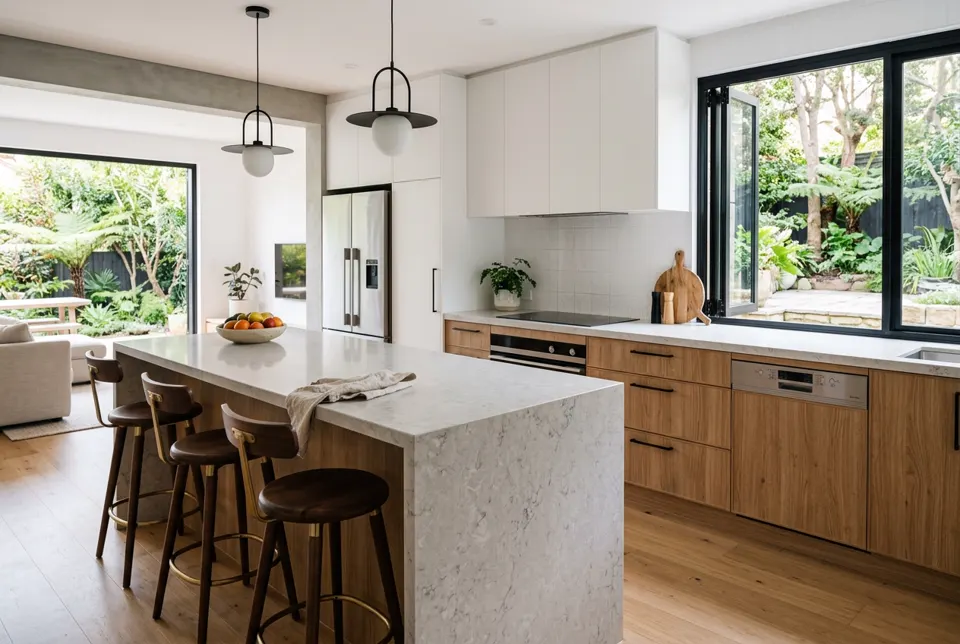
Kitchen renovations in Sydney: where to start
Kitchen renovations in Sydney can mean anything from new doors and a benchtop to moving walls and rewiring the whole room. Work out the layout, appliances and storage you need before choosing colours and finishes. Get that right, and quotes from different trades become much easier to compare.
List appliances and how you cook, then test the layout. Removing walls or relocating services adds a different layer of work to replacing cabinets in an existing footprint.
What’s usually included
Every property is different, but a good quote for kitchen renovations should spell out items like these.
- Measured design and appliance schedule
- Cabinetry and benchtop specifications
- Licensed service alterations
- Splashback and flooring interfaces
- Installation and disposal
How much does it cost?
Most Australian kitchen renovations cost about $15,000–$40,000, and luxury kitchens can go well past $40,000. Another 2026 guide puts most kitchens at $20,000–$65,000+.
Total project cost from national guides (not Sydney-specific). Cabinetry is usually the biggest single cost, often 30–40% of the budget. Layout changes, structural work and premium appliances add more.
Cabinet complexity, benchtop fabrication, appliances and structural changes affect price. Itemise supply and installation, and clarify who connects each appliance.
Indicative ranges only, compiled October 2026 from Canstar – How much does a kitchen renovation cost in Australia in 2026? (citing hipages), Three Birds Renovations – How much does a home renovation cost in 2026?. Your quote depends on your property and scope.
How long it takes: Installation often takes two to four weeks once cabinets arrive, and custom joinery adds manufacturing lead time beforehand.
Licences, insurance and approvals
In NSW, kitchen work worth more than $5,000 (incl. GST) usually needs a contractor licence, such as kitchen, bathroom and laundry renovation, joinery or general building. Plumbing, gas and electrical connections must be done by licensed trades, whatever the cost.
Every member of our crew has their NSW licence verified and insurance sighted before joining, and agrees to quote in writing with their licence number shown. Before you sign, confirm the licence number on the quote using the NSW Government licence check, and make sure residential work over $5,000 (including GST) has a written contract.
Have these details ready
A clear brief gets you faster, more accurate quotes.
- Appliance models and layout changes
- Storage needs and finish preferences
- Walls proposed for removal
- Access and household timing
Kitchen renovations: common questions
Who supplies the appliances?
Both customer-supplied and contractor-supplied arrangements need a clear schedule. Confirm delivery, dimensions, warranty and connection responsibilities.
How long does a kitchen renovation take?
Installation often takes two to four weeks once cabinets are on site, with a plumber, electrician, carpenter and painter each playing a part. Custom cabinetry and stone or porcelain benchtops add manufacturing lead time before that. Ask for a schedule that shows when you will be without a working sink and cooktop.
Can I still get engineered stone benchtops?
No. Australia banned the manufacture, supply and installation of engineered stone benchtops, panels and slabs from 1 July 2024, because of the silicosis risk to workers. Popular alternatives include natural stone, porcelain or sintered surfaces, laminate, timber and stainless steel. Ask your kitchen maker to confirm that your chosen product is compliant.
Flat-pack or custom kitchen: which is better?
Flat-pack cabinets are cheaper and quicker, and they suit standard layouts. Custom cabinetry is made to fit your exact space, with more choice of sizes, finishes and internal fittings. Many kitchens mix both. Compare the carcass material, hinges and drawer runners, because these affect how long the kitchen lasts.
Do I need approval to renovate a kitchen?
A like-for-like kitchen renovation inside a house usually doesn't need council approval. Removing a load-bearing wall, changing the structure or adding floor area may need a CDC or DA. In apartments, strata approval is often needed, especially for flooring, plumbing or work that affects common property.