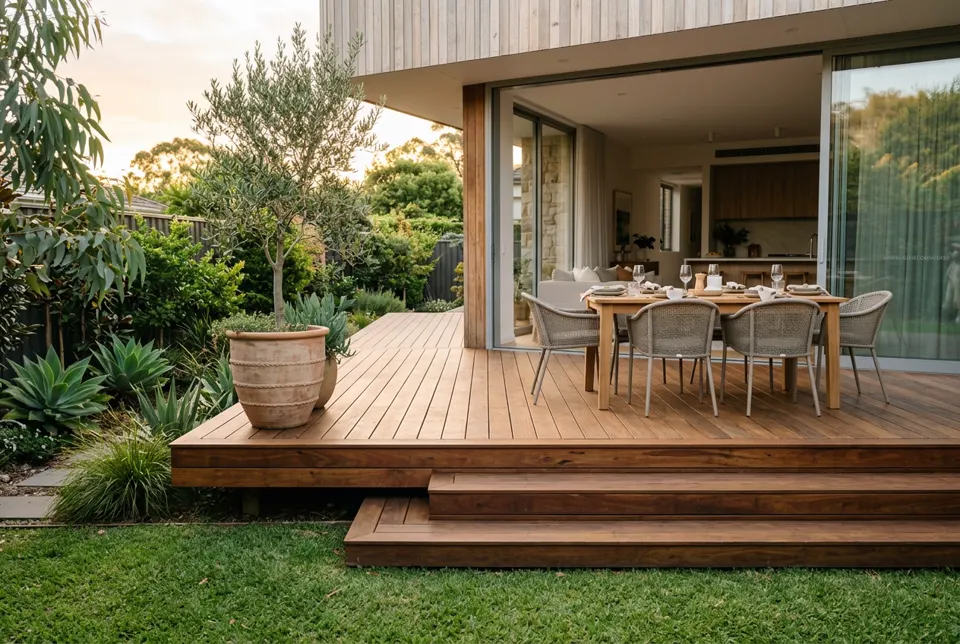
Many Northern Beaches decks are not exempt from approval, because steep blocks put the floor more than 1 metre above the ground. A low deck of 25m² or less can still be exempt if it meets every Codes SEPP standard, but on bushfire-prone land a deck within 5 metres of the house must be non-combustible, and landslip-mapped blocks may need a geotechnical report.
Approval: exempt, CDC or DA?
Northern Beaches Council covers the whole region. Under the state Codes SEPP, a deck can be built without approval only if it meets every exempt standard. On flat blocks in Dee Why or Mona Vale that is often possible. On sloping blocks in Avalon, Newport, Bilgola or Collaroy Plateau, the far edge of the deck often ends up more than 1 metre off the ground, which means you need a complying development certificate (CDC) or a development application (DA).
| Standard (Codes SEPP) | Exempt if | Northern Beaches catch |
|---|---|---|
| Floor height | No more than 1 m above ground | Steep blocks push decks higher |
| Area | No more than 25m² | Big entertaining decks go over |
| Setbacks | At least 900mm from each boundary | Narrow beach lots |
| Front of the house | Behind the building line | Decks facing a street-side view |
| Bushfire-prone land | Non-combustible if within 5 m of the house | Much of the plateau and peninsula is mapped |
Summary only. Read our guide to deck council approval in NSW and check the current Codes SEPP or ask a certifier.
Steep blocks and landslip mapping
Parts of the Northern Beaches are mapped for landslip or geotechnical risk, under maps carried over from the former Warringah and Pittwater councils. Depending on the category and how much digging the footings need, council may ask for a geotechnical report from an engineer or engineering geologist. This mostly comes up when a deck needs a DA or deep footings on a slope.
Footings on these blocks can mean sandstone, deep clay or fill. A builder should look at the site before quoting a fixed price. Decks with a fall of more than 1 metre also need a compliant balustrade, which matters on high decks over a slope.
Check your block first. Northern Beaches Council's online maps or a Section 10.7 certificate show bushfire, landslip, coastal and flood constraints. Do this before you pay for drawings.
Salt air, bushfire and materials
Salt is hard on fixings. Close to the surf, ask for stainless steel screws, bolts and joist hangers rated for marine exposure, usually 316 grade, and avoid mixing metals that react with each other. Hardwood decking needs regular oiling in sun and salt. Composite boards need less upkeep but still need cleaning, and some get hot underfoot on west-facing decks.
On bushfire-prone land, the material rules get tighter. A deck needing approval will usually be assessed for a bushfire attack level (BAL), and the Australian Standard AS 3959 sets which timbers and products suit each level. Some hardwoods and some composite products are tested for higher BAL ratings, so ask the builder to show the product's BAL rating in writing.
- Ask about the subframe as well as the boards. Treated pine joists close to the ground on bushfire land, or galvanised steel near the beach, may not suit.
- Leave gaps under the deck easy to clean, because leaves under a deck are an ember risk.
What to tell the crew when you ask for quotes
Give the size, how high the deck will be at its highest point, and photos of the slope taken from a safe spot. Say whether you are on bushfire-prone or landslip-mapped land, how close you are to the beach, and whether you prefer timber or composite. Mention access, such as a steep driveway or stairs down to the backyard, because materials may have to be carried in by hand.
Read our guides to deck council approval in NSW, composite vs timber decking, deck building costs in Sydney and the deck planning checklist. See the main deck builders service and our Northern Beaches local guide. When you're ready, describe the job to MyTradeCrew and we'll match you with up to three vetted local trades from our crew who quote you directly.
Common questions
Do I need a DA for a deck on a sloping Northern Beaches block?
Often, yes. If any part of the deck floor is more than 1 metre above the ground, it is not exempt. Many decks like this can go through a complying development certificate, which is usually faster than a DA. Bushfire, landslip or coastal constraints can mean a DA instead. A certifier or council can confirm the pathway.
Timber or composite for a deck near the beach?
Both can work. Hardwood looks natural but needs regular oiling to cope with salt and sun. Composite needs less upkeep but varies in heat, colour fade and fire rating. Whatever you choose, the fixings and subframe matter as much as the boards. Ask for marine-rated stainless fixings close to the surf.
What changes if my land is bushfire-prone?
An exempt deck within 5 metres of the house must be made of non-combustible material. A deck that needs approval will usually be assessed for a bushfire attack level, which sets which timbers and products can be used. Ask the builder for the BAL rating of the boards and subframe in writing.
Who checks whether my block is landslip-affected?
Start with Northern Beaches Council's online maps or a Section 10.7 certificate. If your block is mapped and the deck needs a DA or deep footings, council may ask for a geotechnical report. Your builder or designer can help organise one with a geotechnical engineer.
More on deck builders
Scope checklists, price drivers and quote comparisons are on the main Deck builders in Sydney page. For costs, read Deck Building Cost Sydney: Per m², Timber vs Composite.