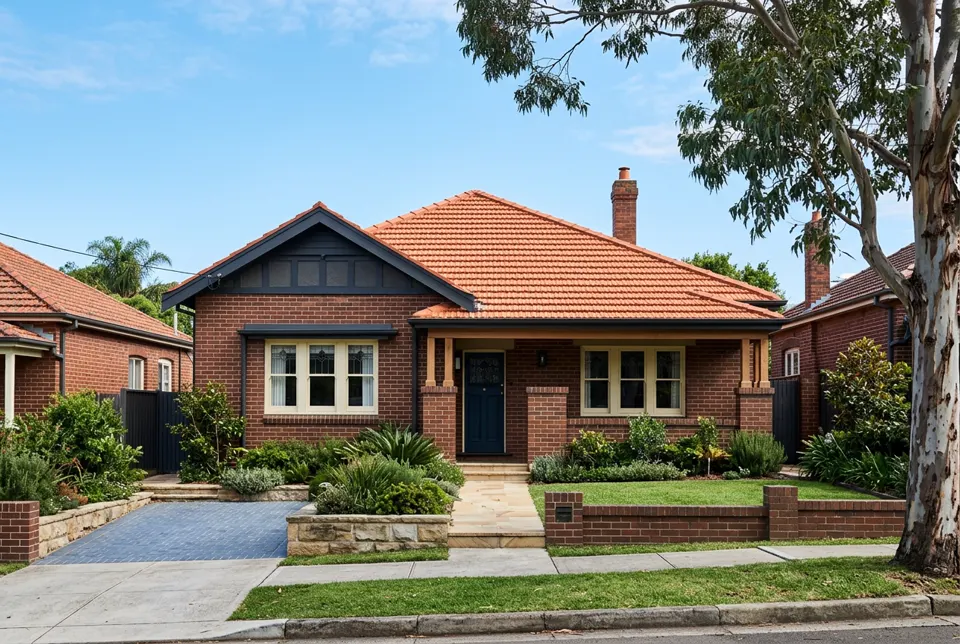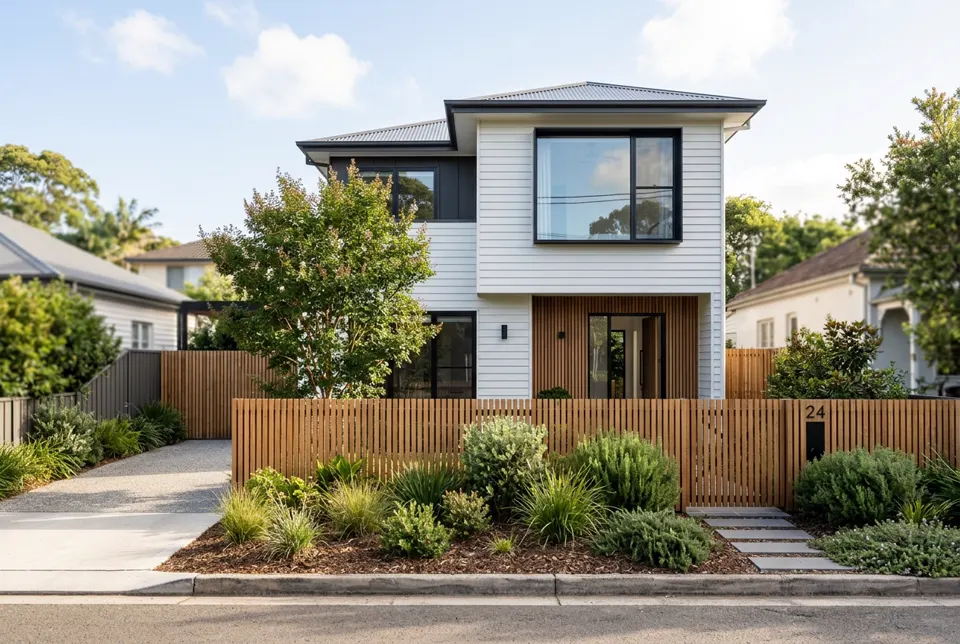
Cladding is the outer layer fixed to the walls of a house to keep out rain and weather and give the home its look. It does not hold the building up. Common types on Sydney houses are fibre cement, timber and engineered timber weatherboards, vinyl, metal such as Colorbond steel, and rendered panels. In NSW, as of October 2026, recladding a one or two storey house can be exempt development only if it does not use combustible cladding, according to NSW Planning.
- Cladding is a non-structural outer skin on a building’s walls; a wall wrap or drained cavity usually sits behind it.
- NSW Planning says cladding can be exempt development only on one and two storey houses, and never with combustible cladding such as metal composite panels or foam-insulated systems.
- Aluminium composite panels with a core of more than 30% polyethylene by mass have been banned on many apartment and other buildings in NSW since 15 August 2018.
- James Hardie says its fibre cement is deemed non-combustible under the National Construction Code; Weathertex says its boards suit bushfire levels up to BAL-19.
- Asbestos NSW says many homes built or renovated before 1990 still contain asbestos, so old fibro cladding should be tested before it is cut or removed.
What is cladding on a house?
Cladding is a layer of boards, sheets or panels fixed over a building’s frame or existing walls. Its main job is to shed rain and protect the structure from sun and wind. It also sets the style of the home, from classic weatherboards to flat modern panels.
On a timber or steel framed house, the cladding is the outside wall. On a brick home, new cladding is usually fixed to battens over the brick. Either way, the cladding does not carry the weight of the roof or floors.
Cladding can also help with fire resistance, noise and insulation, but how much depends on the whole wall system, not just the outer boards.
What are the main types of cladding?
Sydney homes mostly use fibre cement, timber, engineered timber, vinyl, metal or rendered panels. The table compares them.
| Type | What it is | Upkeep | Fire and bushfire notes | Indicative installed cost per m² |
|---|---|---|---|---|
| Fibre cement weatherboards and panels | Cement, sand and cellulose fibre boards, for example HardiePlank or Linea | Paint, then repaint over time | James Hardie says its fibre cement is deemed non-combustible under the NCC | $90 to $160 for weatherboards; $110 to $200 for panels |
| Timber weatherboards | Pine, hardwood or cedar boards | Regular painting or staining | Burns; higher bushfire levels need set species or extra protection | $100 to $180; cedar or premium hardwood $150 to $250 |
| Engineered timber boards | Wood fibre boards, for example Weathertex (97% hardwood, 3% natural wax) | Paint | Weathertex says suitable up to BAL-19 | No separate figure; timber-look composite boards $120 to $220 |
| Vinyl weatherboards | PVC boards made to look like weatherboards | Wash; no painting | Combustible; check suitability on bushfire-prone land | $60 to $120 |
| Metal | Colorbond steel or aluminium sheet profiles | Hose down sheltered areas every six months, more often near the sea | Steel sheet is one of the listed wall options at BAL-29 | $80 to $150 corrugated; $150 to $250 standing seam |
| Rendered panels | Foam (EPS) or aerated concrete (AAC) panels, then rendered | Repaint render; fix cracks | Foam-insulated systems count as combustible cladding in NSW | $70 to $120 EPS; $110 to $180 AAC |
| Brick slips and stone veneer | Thin brick or stone fixed to a backing | Low | Ask for the system’s fire test data | $180 to $300 brick slips; $150 to $350 stone veneer |
Costs: Yakka Labour cladding cost guide 2026 (national, single storey, including GST, excluding painting and removal of old cladding). Fire notes: James Hardie, Weathertex, NSW Planning and the BAL-29 construction sheet cited below. See our Cladding Cost Sydney guide for more price sources.
What is weatherboard cladding?
Weatherboard cladding is long horizontal boards fixed so each one overlaps or locks into the board below, which sheds water. It is the classic look of many older Sydney homes, and it now comes in timber, fibre cement, engineered timber and vinyl.
- Fibre cement weatherboards: James Hardie’s HardiePlank is 7.5 mm thick with a 25-year product warranty. Its thicker Linea board is 16 mm and also lists a 25-year warranty.
- Engineered timber weatherboards: Weathertex says its primed weatherboards are guaranteed not to rot, split or crack for 25 years, and its natural range for 10 years.
- Vinyl weatherboards: these need no painting, which keeps upkeep low. They are usually among the cheapest options to install.
- Timber weatherboards: the traditional choice. They look warm and can be repaired board by board, but they need regular painting.
Warranties have conditions, such as correct installation and maintenance, so read them before you choose.
What goes behind the cladding?
Behind most cladding is a wall wrap, also called a pliable building membrane or sarking. It stops rain that gets past the cladding from reaching the frame, while letting water vapour escape.
The National Construction Code 2022 Housing Provisions say this membrane must comply with AS 4200.1, be installed to AS 4200.2 and sit on the outside of the main insulation layer. Without one, the wall usually needs a drained cavity instead.
When cladding goes over brick, installers fix battens first. That leaves a gap for drainage and room for insulation. A good installer will also plan the flashings around windows, doors and the base of the wall, which is where most leaks start.
Is cladding a fire risk? Rules for houses and apartments in NSW
Most house cladding is not banned, but NSW has strict rules on combustible cladding, especially on apartments.
- Houses: NSW Planning says cladding, re-cladding and decorative work can be exempt development only on one and two storey dwelling houses, and attached or detached development. The work must not use combustible cladding and must comply with the Building Code of Australia. It cannot be exempt on state heritage items and some other protected land.
- What counts as combustible: NSW Planning uses the regulation’s definition. It covers cladding made of metal composite panels, including aluminium, zinc and copper, and any insulated cladding system, such as polystyrene, polyurethane or polyisocyanurate.
- Apartments and many other buildings: since 15 August 2018, NSW has banned aluminium composite panels with a core of more than 30% polyethylene by mass on many buildings. The ban covers apartment, hotel, hospital and similar buildings of two or more storeys, and offices, shops, warehouses and factories of three or more storeys.
- Registration: owners of apartments and other buildings where people sleep, two storeys or higher, with metal composite panels or insulated cladding must register them with the NSW Government. The NSW Government says this rule does not apply to houses.
- Project Remediate: this NSW program gave owners corporations of high-risk Class 2 apartment buildings 10-year interest-free loans to replace combustible cladding. Registrations have now closed.
Houses over two storeys, heritage items and any job using metal composite panels or foam-insulated panels cannot be done as exempt development. Ask your installer for the product’s fire test data, and check with your council or a certifier before work starts.
Which cladding suits bushfire-prone land?
On bushfire-prone land, the cladding must suit your bushfire attack level (BAL). The NSW Rural Fire Service says there are six levels, from BAL-Low to BAL-FZ (flame zone), and that AS 3959 sets the construction rules for each.
- At BAL-29, a Clarence Valley Council construction sheet based on AS 3959 lists non-combustible walls such as brick veneer or AAC. A framed wall can be used if it is sarked and clad with fibre cement at least 6 mm thick, steel sheet or bushfire-resisting timber.
- WoodSolutions lists bushfire-resisting timbers including Blackbutt, Spotted Gum, Red Ironbark, Silvertop Ash, Turpentine, River Red Gum and Kwila (Merbau). At BAL-40 and BAL-FZ it says lightweight timber cladding systems need a tested fire-resistance level of 30/30/30.
- Product claims: Weathertex says its boards suit BAL-Low, BAL-12.5 and BAL-19. James Hardie lists BAL-40 for some weatherboard ranges, including Linea. Check the exact product and its installation details.
The RFS says upgrading an existing home is not mandatory, but new work on bushfire-prone land must meet the rules. It also says complying development is not allowed on the highest risk land, BAL-40 and BAL-FZ.
How do you look after cladding?
Most cladding needs a regular wash, a check of joints and flashings, and repainting if it is a painted product.
- Metal: the Colorbond steel maintenance page says to hose down areas the rain does not reach, such as wall cladding under eaves, at least every six months, and more often near the coast where salt spray is common.
- Timber: Better Homes and Gardens suggests repainting a weatherboard home every 10 to 15 years. Exposed and coastal walls often need it sooner, so follow the paint maker’s advice for your site.
- Fibre cement and engineered boards: keep the paint in good condition and reseal joints as needed, following the maker’s maintenance guide to keep the warranty valid.
- All types: keep gardens, mulch and soil below the bottom edge, clear blocked weep holes and fix leaks early.
Asbestos NSW says many homes built or renovated before 1990 still contain asbestos, and asbestos was totally banned in Australia from 31 December 2003. Do not drill, sand, cut or pressure wash old fibro sheeting until it has been tested.
Get quotes from vetted cladding trades
Planning to clad or reclad? Describe the job to MyTradeCrew: the size and number of storeys of your home, what is on the walls now, the look you want and whether you are on bushfire-prone land. We will send it to up to three vetted, licensed and insured local cladding trades from our crew. They inspect, quote and contract with you directly, and it is free for homeowners.
Frequently asked questions
Is fibro cladding asbestos?
It may be. Fibro is a common name for fibre cement sheeting, and older sheets often contain asbestos. Asbestos NSW says many homes built or renovated before 1990 still contain it. James Hardie says its products have been asbestos-free since 1987. The only way to know is to have a sample tested before anyone cuts, drills or removes it.
Can cladding go over brick?
Yes, in most cases. Installers usually fix timber or metal battens to the brick, then fix the cladding to the battens. This leaves a gap for drainage and space for insulation. Any damp, cracking or drainage problems in the brick should be fixed first, and the installer must plan how the new wall meets windows, doors and eaves.
Does cladding insulate a house?
On its own, only a little. Most of the gain comes from what goes behind it, such as insulation boards or batts between battens, and a suitable wall wrap. Ask your installer what the whole wall system will achieve. Foam-backed or foam panel systems can add insulation, but in NSW they count as combustible cladding.
Do I need a licence to install cladding in NSW?
A licensed contractor is needed if the work is worth more than $5,000 in labour and materials including GST. The NSW Government says carpentry work includes exterior wall cladding, excluding brick, and cladding removal and replacement is also listed under general building work. Check the licence on Verify NSW before you sign.
What is the cheapest type of cladding?
Vinyl weatherboards are usually the cheapest to install in Australian cost guides. Yakka Labour’s 2026 guide puts them at about $60 to $120 per m², against $90 to $160 for fibre cement weatherboards, which also need painting. Lifetime cost depends on upkeep, so compare painting and maintenance too. Our Cladding Cost Sydney guide has the full comparison.
Ready to get quotes?
Compare up to 3 licensed, insured cladding installation trades near you. Free.