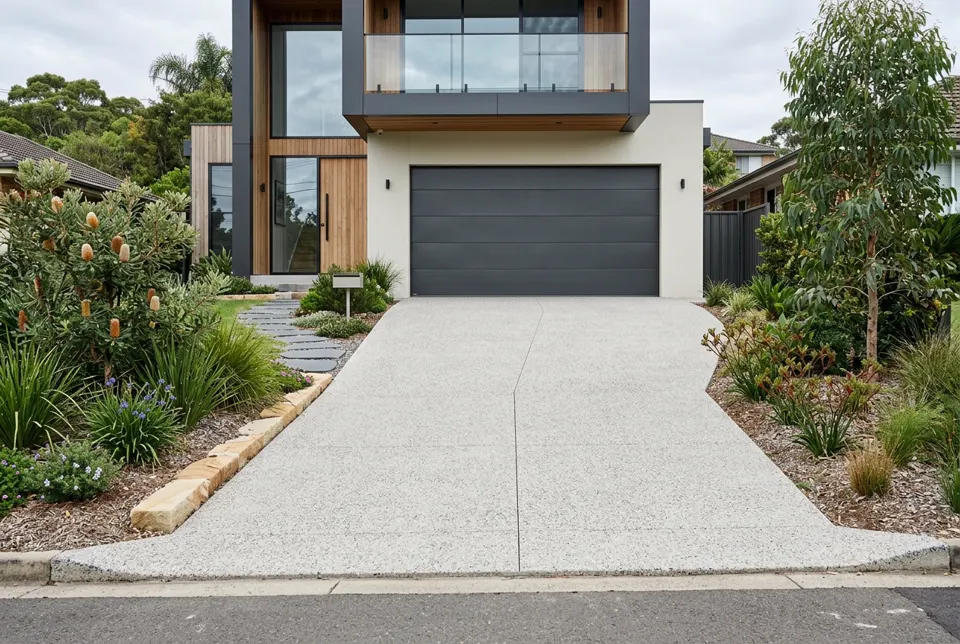
Concrete driveways in Sydney: where to start
Concrete driveways in Sydney need to cope with heavy cars, steep blocks, tree roots and summer storms. A long-lasting driveway depends on good base preparation, the right thickness and reinforcement, and a clear path for stormwater. The finish you choose, whether plain, coloured, exposed aggregate or stencilled, mostly changes the look and the price.
A driveway needs a suitable base and a clear path for water. Identify existing damage, vehicle use and the connection to the street. Work at a crossover may have separate council requirements.
What’s usually included
Every property is different, but a good quote for concrete driveways should spell out items like these.
- Removal and base preparation
- Levels and drainage plan
- Concrete specification and reinforcement details
- Joints and finish selection
- Curing, access and disposal
How much does it cost?
ServiceSeeking's 2026 quote data puts the average concrete driveway or path at about $97 per square metre. Decorative finishes, excavation and difficult access push prices higher.
Average quoted price per m² across Australia (not Sydney-specific). Removing an old driveway, extra excavation, reinforcement, exposed aggregate and council crossover works add to the total.
Excavation, thickness, access, drainage and finish affect price. Ask when vehicles can return and who is responsible for any crossover approvals.
Indicative ranges only, compiled October 2026 from ServiceSeeking – Concrete driveway and path costs: 2026 price guide. Your quote depends on your property and scope.
How long it takes: Preparing and pouring a driveway often takes a few days, and the concrete then needs at least seven days of curing before normal use.
Licences, insurance and approvals
In NSW, concreting work worth more than $5,000 (incl. GST) usually needs a contractor licence, such as general concreting or general building. Any work on the crossover between your boundary and the road usually needs council approval under section 138 of the Roads Act.
Every member of our crew has their NSW licence verified and insurance sighted before joining, and agrees to quote in writing with their licence number shown. Before you sign, confirm the licence number on the quote using the NSW Government licence check, and make sure residential work over $5,000 (including GST) has a written contract.
Have these details ready
A clear brief gets you faster, more accurate quotes.
- Approximate area and vehicle use
- Existing surface condition
- Slope and drainage problems
- Street connection and site access
Concrete driveways: common questions
Is resurfacing equivalent to replacement?
Resurfacing retains the existing base. Its suitability depends on the condition and cause of damage; compare it with replacement only after assessment.
How long before I can drive on a new concrete driveway?
Concrete gains strength over time. Concrete supplier Holcim recommends curing it for at least seven days. Many contractors advise waiting about a week before driving a car on it, and longer for heavy vehicles. Ask your concreter for a specific date based on the mix and the weather, and keep vehicles off until then.
Which driveway finish is best?
Plain broom-finished concrete is the most affordable and gives good grip. Exposed aggregate shows the stones in the mix and hides dirt and tyre marks well. Coloured and stencilled concrete look decorative but may need resealing. On steep Sydney driveways, ask about slip resistance before choosing a smooth finish.
Why does concrete crack?
Concrete shrinks as it dries and moves with temperature and ground changes, so some fine cracking is normal. Control joints are cut in so cracks form in neat lines. Wider cracks, lifting or sinking usually point to poor base preparation, tree roots or drainage problems, so ask how your contractor will prevent these.
Do I need approval for a new driveway crossover?
Usually, yes. The section between your boundary and the road, including the footpath and nature strip, belongs to the road reserve. Building or changing it needs consent from the roads authority, usually your council, under section 138 of the Roads Act. This is separate from any DA or CDC for the house.