As an indicative guide (October 2026), a new concrete driveway in Sydney costs about $86 to $170 per m² for plain concrete and about $140 to $230 per m² for exposed aggregate or stencilled finishes, according to the What's The Damage Sydney concreting guide. A typical 40m² driveway works out at roughly $3,000 to $6,900 plain, or $5,500 to $10,350 in exposed aggregate. Removing an old driveway and council approval for the kerb crossing are usually extra.
The short answer
As an indicative guide (October 2026), a new concrete driveway in Sydney costs about $86 to $170 per m² for plain concrete and about $140 to $230 per m² for exposed aggregate or stencilled finishes, according to the What's The Damage Sydney concreting guide. A typical 40m² driveway works out at roughly $3,000 to $6,900 plain, or $5,500 to $10,350 in exposed aggregate. Removing an old driveway and council approval for the kerb crossing are usually extra.
These figures are a starting point. Your price depends on the size, the finish, the ground under the slab and how easy your site is to reach.
Indicative prices by finish (October 2026)
What's The Damage gives these Sydney prices per m² (low to high, with a typical figure), verified October 2026 and including GST:
- Plain concrete: $86 to $170 per m² (typical about $125).
- Coloured concrete: $110 to $230 per m² (typical about $160).
- Exposed aggregate: $140 to $230 per m² (typical about $185).
- Stencilled or stamped: $140 to $230 per m² (typical about $180).
The same publisher's national guide gives lower ranges for Australia as a whole: plain $75 to $150, coloured $95 to $200, and exposed aggregate or stamped $120 to $200 per m². The Sydney figures are higher, so use them for a Sydney budget.
Removing old concrete adds about $34 to $115 per m², plus tip fees of about $150 to $400, according to the Sydney guide.
Plain, exposed aggregate or stencil?
Plain concrete is usually finished with a broom to give some grip. It is the simplest and lowest-cost option.
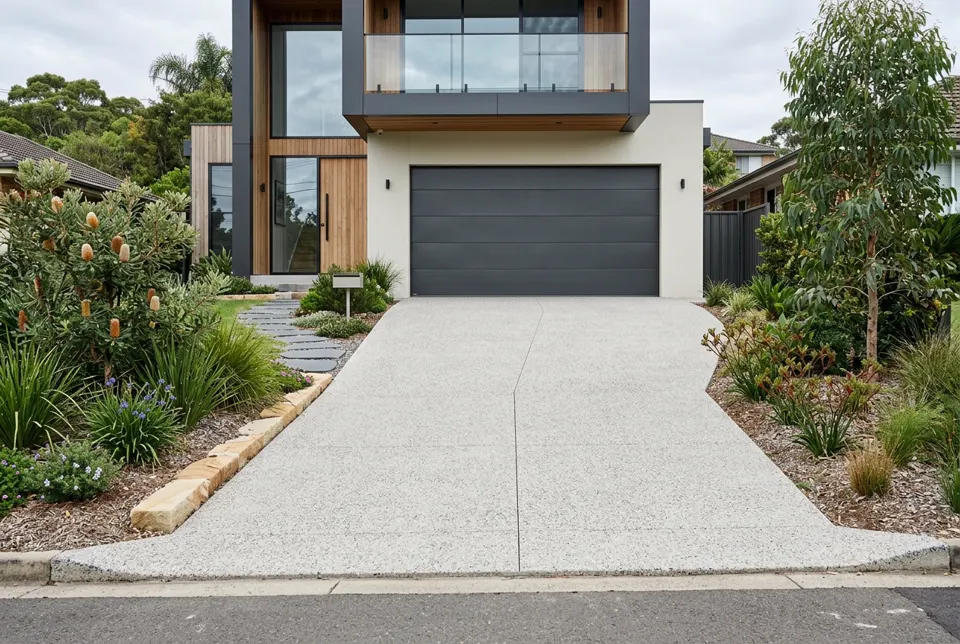
Exposed aggregate has the top layer of cement washed away to show the stones in the mix. It has a textured look and comes in many stone colours. It takes more labour, so it costs more.
Stencilled or stamped concrete uses patterns and coloured surface coatings to look like pavers, tiles or stone. Ask how often the surface will need resealing.
Coloured concrete has colour mixed through it. It sits between plain and decorative finishes on price.
What drives the cost
- Size: larger driveways spread set-up costs, so the per-m² price can drop.
- Finish: decorative finishes take more time and materials.
- Demolition: removing and disposing of an old driveway adds cost.
- Ground preparation: digging, levelling, road base and compaction.
- Thickness and steel: driveways for heavier vehicles may need a thicker slab or more reinforcement.
- Slope and access: steep driveways and tight sites take longer. A concrete pump may be needed.
- Drainage: grates, channels and pipes to manage stormwater.
- Joints and sealing: control joints help manage cracking, and sealers protect some finishes.
- The council crossing: the section over the footpath and kerb has its own approval and rules.
What a quote should include
Ask each concreter to list these items so you can compare quotes fairly:
- Removal and disposal of the old driveway, including tip fees.
- Excavation, base material and compaction.
- Slab thickness, reinforcement and concrete strength.
- The finish, colour and any sealer.
- Formwork, control joints and edges.
- Drainage work.
- The kerb crossing, permit fees and any council inspections, or a note that these are excluded.
- How long before you can walk and drive on it.
The NSW Government recommends giving each contractor the same written brief so quotes can be compared.
Council approval for the driveway crossing
The part of a driveway that crosses the footpath, nature strip and kerb is on public land. It is often called the vehicle crossing or crossover. Building, repairing or changing it needs consent under section 138 of the Roads Act 1993.
Your local council is the roads authority for most local streets. On some classified roads, Transport for NSW may also need to approve the work. The NSW Planning Portal says to contact your council first to confirm the process, the documents you need and the fees. If the driveway is part of a bigger project, apply after your DA is approved or before a CDC is issued.
Councils may set the levels, width and specifications for the crossing. Some charge permit and inspection fees and hold a security deposit. Check your own council's current fees and requirements.
Driveways and paving inside your property may be exempt development if they meet the Codes SEPP standards. Check those standards on the NSW Planning Portal, especially if you plan to change ground levels or how stormwater flows.
Licences and contracts
Concreting is a licensed trade in NSW, listed as general concreting. A contractor licence is needed for residential work over $5,000 in labour and materials (including GST), and work over $5,000 needs a written contract. The deposit cannot be more than 10%. For work over $20,000, the contractor must give you a Home Building Compensation certificate before taking any money.
Ask your concreter to check for underground services before digging, for example through Before You Dig Australia (BYDA).
Plan for curing and care
New concrete needs time to cure and gain strength. Ask your concreter when it is safe to walk on, when you can park a car on it, and how long to keep heavy vehicles such as trucks and skip bins off it. Follow their advice, even if the surface looks dry.
Plan where you will park during the work and how you will get in and out of your home. Ask what care your chosen finish needs over time, such as cleaning or resealing, and get those instructions in writing.
Questions to ask your concreter
- What thickness, reinforcement and concrete strength will you use, and why?
- Does your price include removing the old driveway and tip fees?
- Who applies for the council crossing approval, and is the crossing included?
- How will stormwater drain away from the house and off the driveway?
- Where will control joints go?
- What is your contractor licence number?
- What warranty do you give, and what does it cover?
Get your driveway quoted
Describe your driveway job to MyTradeCrew. Tell us the rough size, the finish you like, whether an old driveway needs removing and how trucks can reach the site. We will try to match you with vetted, licensed and insured local concreters who can measure up and give you a written quote.
Frequently asked questions
How much does a concrete driveway cost per m² in Sydney?
The What's The Damage Sydney guide (October 2026) gives about $86 to $170 per m² for plain concrete, $110 to $230 for coloured, and $140 to $230 for exposed aggregate or stencilled finishes. These are indicative prices, not quotes.
Is exposed aggregate more expensive than plain concrete?
Yes. In the same Sydney guide, a typical 40m² driveway costs about $3,000 to $6,900 in plain concrete and about $5,500 to $10,350 in exposed aggregate, because the finish takes more labour.
Do I need council approval for a new driveway in Sydney?
The section that crosses the footpath, nature strip and kerb needs consent from the roads authority under section 138 of the Roads Act 1993, usually your council. Work inside your property may be exempt if it meets the Codes SEPP standards.
Does a driveway quote include removing the old concrete?
Not always. Removal can add about $34 to $115 per m² plus tip fees in Sydney, according to What's The Damage. Ask each concreter to show removal as a separate line item.
Who pays for the driveway crossing?
Usually the property owner arranges and pays for the crossing works and council fees, but rules differ between councils. Check with your council before you sign a quote.
Ready to get quotes?
Compare up to 3 licensed, insured concrete driveways trades near you. Free.