Custom joinery in Sydney: where to start
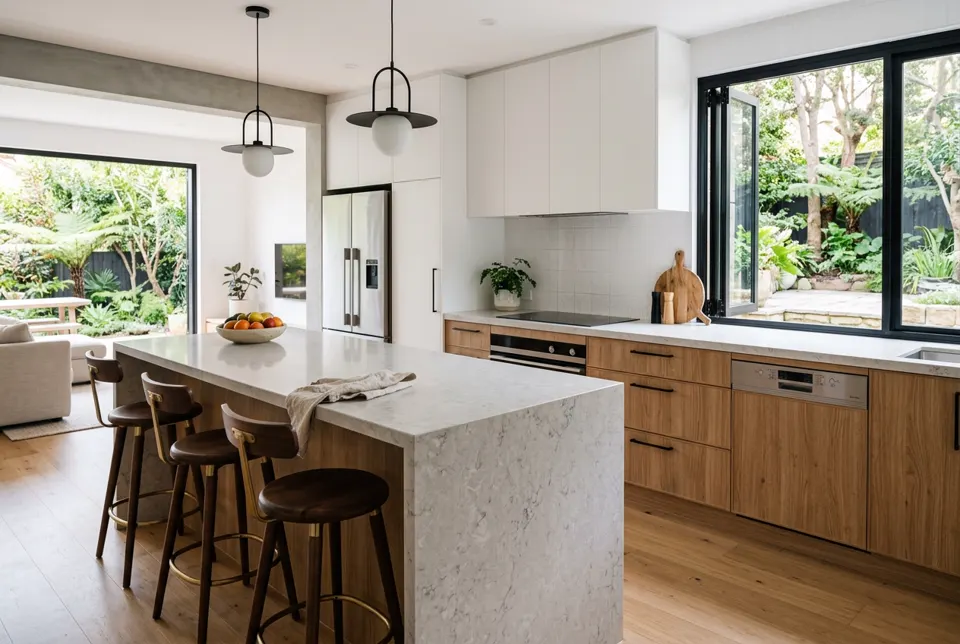
Custom joinery in Sydney covers built-in wardrobes, TV units, home offices, laundries, window seats and storage made to fit your exact space. It suits awkward alcoves, sloping ceilings and rooms where off-the-shelf furniture wastes space. Good joinery starts with a measured plan of what you need to store, then finishes and hardware.
List what needs to be stored and how often it is used. Decide on internal fittings before selecting door finishes, so the visible design supports practical storage.
What’s usually included
Every property is different, but a good quote for custom joinery should spell out items like these.
- Site measure and drawings
- Materials, hardware and finish schedule
- Internal storage configuration
- Installation and wall interfaces
- Making good and product care
How much does it cost?
Built-in wardrobes in Sydney commonly cost about $1,000–$5,000 each, and premium custom joinery starts at around $6,000. Nationally, built-ins run about $1,110–$3,010+ per linear metre.
Supply and installation, including labour and materials. The per-metre range goes from basic to premium finishes. Walk-in robes, complex internal fittings and premium hardware cost more.
Dimensions, finishes, hardware and installation complexity affect price. Confirm which drawings are approved before fabrication.
Indicative ranges only, compiled October 2026 from Airtasker – How much do built-in wardrobes cost in Australia in 2025? (updated Feb 2025). Your quote depends on your property and scope.
How long it takes: Installing a built-in wardrobe often takes about 5 to 15 hours, after the joiner's design and manufacturing lead time.
Licences, insurance and approvals
In NSW, joinery is a licensed trade, so supplying and installing custom joinery worth more than $5,000 (incl. GST) usually needs a contractor licence for joinery or general building.
Every member of our crew has their NSW licence verified and insurance sighted before joining, and agrees to quote in writing with their licence number shown. Before you sign, confirm the licence number on the quote using the NSW Government licence check, and make sure residential work over $5,000 (including GST) has a written contract.
Have these details ready
A clear brief gets you faster, more accurate quotes.
- Room dimensions
- Storage priorities
- Finish references
- Site access and timing
Custom joinery: common questions
What should I approve before manufacture?
Confirm drawings, dimensions, materials, hardware and internal layout. Record changes before fabrication to avoid costly remakes.
How long does custom joinery take?
Most of the time goes into design, approval of drawings and manufacturing. Installation itself is often quick. For example, Airtasker's guide says a built-in wardrobe install typically takes about 5 to 15 hours. Ask your joiner for the lead time from final sign-off to installation day.
What materials are used for custom cabinets?
Most built-in cabinets use board such as MDF or particleboard, finished in laminate, two-pack paint, timber veneer or thermolaminate. Moisture-resistant board is used in wet areas. Solid timber is sometimes used for doors or benchtops. Ask about edging on exposed edges and how each finish handles knocks and cleaning.
Is custom joinery worth it compared with flat-pack?
Custom joinery costs more, but it uses every centimetre of the space, including full ceiling height and odd corners. It is built to suit your walls, so gaps and filler panels are kept to a minimum. Flat-pack can be cheaper for standard spaces, and many homes mix both.
Which hardware should I ask about?
Hinges, drawer runners and lift-up stays take the most wear. Soft-close hinges and full-extension runners from known brands usually last longer. Ask what weight ratings and warranties apply, especially for heavy drawers, tall doors and pull-out fittings. Spending a little more on hardware is often the easiest way to make joinery last.