As an indicative guide (October 2026), a retaining wall in Sydney costs roughly $230 to $860 per lineal metre depending on the material, according to the What's The Damage Sydney guide, and a 10m wall about 1m high costs about $2,875 to $8,050. In NSW, a wall no more than 600mm high and at least 1 metre from boundaries can usually be built without approval as exempt development. Taller walls, or walls closer to a boundary, need approval and usually an engineer's design.
The short answer
As an indicative guide (October 2026), a retaining wall in Sydney costs roughly $230 to $860 per lineal metre depending on the material, according to the What's The Damage Sydney guide, and a 10m wall about 1m high costs about $2,875 to $8,050. In NSW, a wall no more than 600mm high and at least 1 metre from boundaries can usually be built without approval as exempt development. Taller walls, or walls closer to a boundary, need approval and usually an engineer's design.
A retaining wall holds back soil. That soil is heavy, and it gets heavier when it is wet. Good design and drainage matter more than the look of the wall.
Indicative prices by material (October 2026)
What's The Damage gives these Sydney prices per lineal metre (low to high, verified October 2026):
- Timber sleeper: $230 to $520 per lineal metre.
- Concrete sleeper: $345 to $690 per lineal metre.
- Besser or concrete block: $345 to $860 per lineal metre.
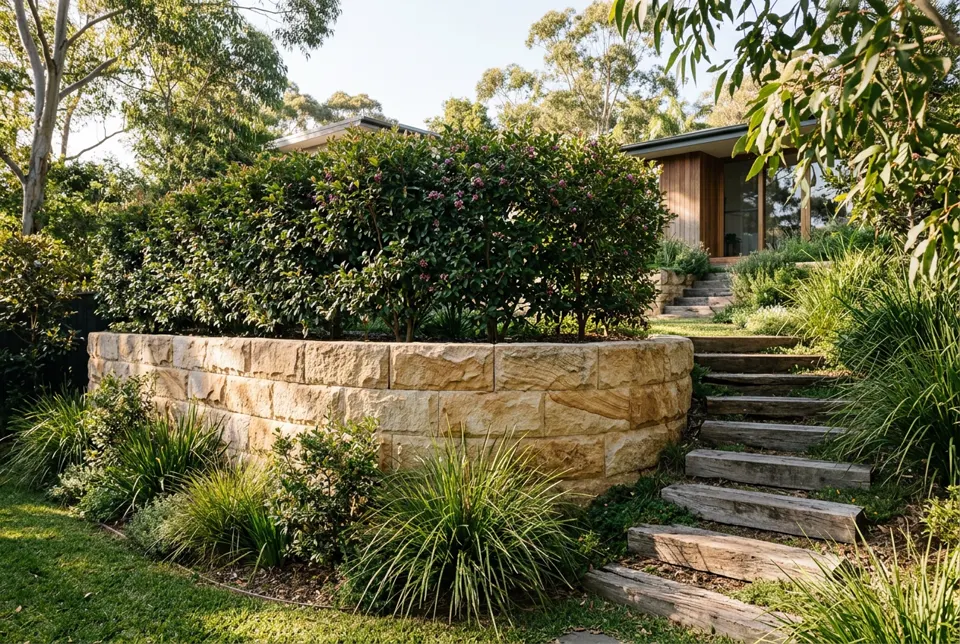
- Sandstone: $400 to $805 per lineal metre.
- Boulder: $290 to $690 per lineal metre.
- Gabion: $345 to $920 per lineal metre.
The same guide gives example totals of $1,150 to $3,225 for a small wall (5m long, 0.5m high), $2,875 to $8,050 for a standard wall (10m by 1m) and $5,750 to $17,250 for a large wall (15m by 1.5m).
Airtasker's national cost guide uses square metres of wall face instead. It lists, for example, block at $98 to $152 per m², timber sleeper at $249 to $353 per m², sandstone at $205 to $495 per m² and concrete at $353 to $555 per m².
The two guides use different units and do not line up neatly. Ask every contractor to price the same length, height and material so you can compare like with like.
Extra costs to plan for
What's The Damage lists these Sydney add-ons (October 2026):
- Engineering or structural certificate: $575 to $2,300.
- Drainage behind the wall: $34 to $92 per lineal metre.
- Removing an old wall: $57 to $205 per lineal metre.
- Geotechnical soil report: $575 to $2,875.
- Council approval fees for taller walls: $520 to $2,075.
Fees vary by council and by site. Treat these as a rough guide only.
What drives the cost
- Height: taller walls hold back more soil and need stronger footings and design.
- Length: more metres means more material and labour.
- Material: timber, concrete sleepers, blocks and stone all differ in price and life span.
- Soil and rock: clay, sand or rock change how deep you dig and how strong the footing must be.
- Access: if a machine cannot reach the site, work is done by hand, which takes longer.
- Loads above the wall: a driveway, house, pool or steep slope behind the wall adds pressure.
- Drainage: gravel backfill, a slotted drain pipe and fabric filter are needed to stop water building up.
- Approvals and reports: engineering, soil testing and fees add to the total.
NSW approval rules for retaining walls
Under the Codes SEPP, a retaining wall can be exempt development (no approval needed) only if it meets all the standards. Key ones include:
- The wall is no more than 600mm high, and any cut or fill is no more than 600mm.
- It is at least 1 metre from each lot boundary.
- It is at least 40 metres from a natural body of water.
- It does not redirect surface water or groundwater, or wash sediment onto a neighbour's land.
- It is at least 2 metres horizontally from any other retaining wall on the site.
- It is not on a heritage item. In a heritage conservation area, it must be in the rear yard.
- It is structurally adequate and meets the Building Code of Australia.
The NSW Planning Portal page sets out the location and drainage standards. The 600mm height and 1 metre setback limits are in the Codes SEPP. Walls that do not meet the exempt standards need a complying development certificate (CDC) or a development application (DA). A certifier or your council can confirm which applies.
When you need an engineer
Ask for an engineer's design when a wall needs approval, holds up a driveway, building or pool, or sits on a steep or wet site. Your certifier or council will usually ask for one for taller walls. A geotechnical engineer may be needed to test the soil.
If an existing wall is leaning, cracking, bulging or leaking water, keep people away from it and get it checked by a qualified professional.
What a good quote should cover
- Digging, removing soil and disposal.
- Footings and any reinforcement.
- The wall material, posts or blocks.
- Drainage: gravel, drain pipe, filter fabric and where the water will go.
- Backfill and compaction.
- Engineering, approvals and surveys, or a clear note that these are excluded.
- Removing the old wall and making good the garden or fence afterwards.
Licences and contracts
Retaining walls are usually built under a licence for structural landscaping or general building work. For residential work over $5,000 (including GST), the contractor needs a licence and you need a written contract. The deposit cannot be more than 10%. For work over $20,000, the builder must give you a Home Building Compensation certificate before taking any money.
Questions to ask your tradie
- Is this wall exempt, or does it need a CDC or DA?
- Will an engineer design it? Who pays for that?
- How will water drain from behind the wall, and where will it go?
- What is your contractor licence number and category?
- How long should this material last on my site?
- What happens if you hit rock or find services when digging?
Get your retaining wall quoted
Describe your retaining wall job to MyTradeCrew. Tell us the rough length, height, what the wall is holding back and how a machine could get in. We will try to match you with vetted, licensed and insured local trades who can inspect the site and give you a written quote.
Frequently asked questions
Do I need council approval for a retaining wall in NSW?
Not if the wall meets every exempt standard: no more than 600mm high, at least 1 metre from boundaries, at least 2 metres from other retaining walls, no changes to water flow onto neighbours, and no heritage item. Otherwise you need a CDC or DA.
How high can a retaining wall be without approval in NSW?
Up to 600mm, measured from the base, as long as it also meets the other exempt standards, including a 1 metre setback from boundaries. Walls over 600mm need approval.
What is the cheapest type of retaining wall?
In the What's The Damage Sydney guide (October 2026), timber sleepers have the lowest starting price per lineal metre. In Airtasker's national guide, block walls have a lower per-m² range. The cheapest wall to build is not always the cheapest over its life, so ask about durability.
Does a retaining wall need drainage?
Yes. Water building up behind a wall adds pressure and is a common cause of failure. A good wall has gravel backfill, a slotted drain pipe, filter fabric and a planned outlet for the water.
Do I need an engineer for a retaining wall?
Walls that need approval usually need an engineer's design. Ask for one for any wall that supports a driveway, building, pool or steep slope, even if it is low.
Ready to get quotes?
Compare up to 3 licensed, insured retaining wall construction trades near you. Free.